
Mechanical Vapor Recompression(mvr)evaporator which is compresses secondary vapor to recover latent heat and reuse it for evaporation, enabling low-energy industrial concentration and ZLD wastewater treatment.
Working Principle of MVR Evaporator (Mechanical Vapor Recompression)
MVR evaporator uses a compressor to raise the pressure and temperature of secondary vapor allowing it to be reused as a heating medium in the evaporation cycle.
Secondary vapor pressure: 0.1–0.3 bar (vacuum operation)
Temperature lift after compression: +5 to +20°C
Driving energy: electrical power for vapor compression
Heat mechanism: latent heat recovery through phase change
The Core mechanism: vapor phase energy upgrading via mechanical compression
The basic principle of the mvr Evaporator .
Core Equipment in MVR Evaporator System
Evaporator (falling film / forced circulation evaporator)
Vapor compressor (centrifugal / screw / Roots type)
Vapor–liquid separator
Heat exchanger / condenser
Circulation pump and process control system
Mechanical Vapor Recompression(mvr)evaporator Process Flow (Operation Cycle)
Mvr evaporator Standard Process Sequence
Feed enters evaporator system
Liquid boils and generates secondary vapor
Vapor–liquid separator removes entrained droplets
Vapor is compressed by mechanical compressor
Superheated vapor returns as heating medium
Heat is released through condensation
Concentrated liquid is discharged or recirculated
Mechanical Vapor Recompression(mvr)evaporator Operating Stages
mechanical vapour recompression system is composed of single-effect or double-effect evaporator or multiple effect. Separator. Compressor. Vacuum pump. Circulation pump. Operation platform. Electrical instrument control cabinet and valve. Pipeline and other systems. with simple structure and convenient operation and maintenance.
Startup stage: external heating required to initiate evaporation
Steady-state operation: closed vapor recycling loop
Shutdown stage: anti-scaling and vacuum stabilization control
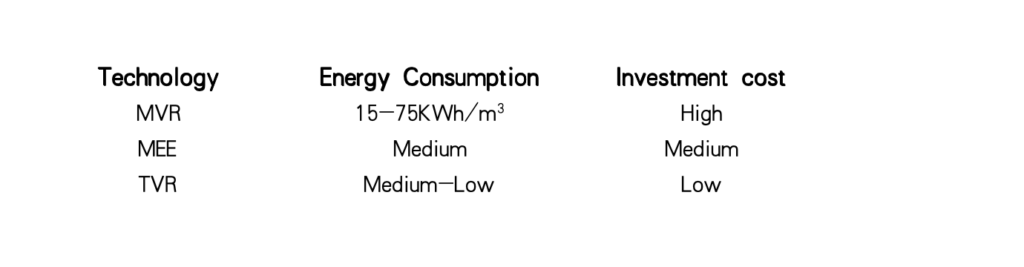
MVR vs MEE vs TVR Technology Comparison
Industrial Applications and ZLD Systems
Typical Industrial Applications
Industrial wastewater concentration (evaporator systems)
Brine and high-salinity wastewater treatment
Chemical solvent and process stream recovery
Pharmaceutical intermediate concentration
Food and beverage evaporation
Zero Liquid Discharge (ZLD) systems
Role of MVR in ZLD Systems
MVR serves as the primary evaporation unit
Pre-treatment reduces scaling and hardness load
Crystallizer handles final solid-liquid separation
System goal: zero liquid discharge with salt recovery
Role of MVR in ZLD Systems
MVR serves as the primary evaporation unit
Pre-treatment reduces scaling and hardness load
Crystallizer handles final solid-liquid separation
System goal: zero liquid discharge with salt recovery
Engineering Constraints and Design Limitations
High boiling point elevation (BPE: 1–8°C) reduces heat transfer efficiency
Scaling tendency increases under high salinity conditions
Feed fluctuation reduces compressor efficiency and system stability
Limited ΔT range (3–15°C) constrains heat exchanger design
Non-condensable gases (NCG) reduce overall heat transfer coefficient
Suggested Engineering Diagrams
Energy Flow Diagram (Mechanical Vapor Recompression(mvr)evaporator)
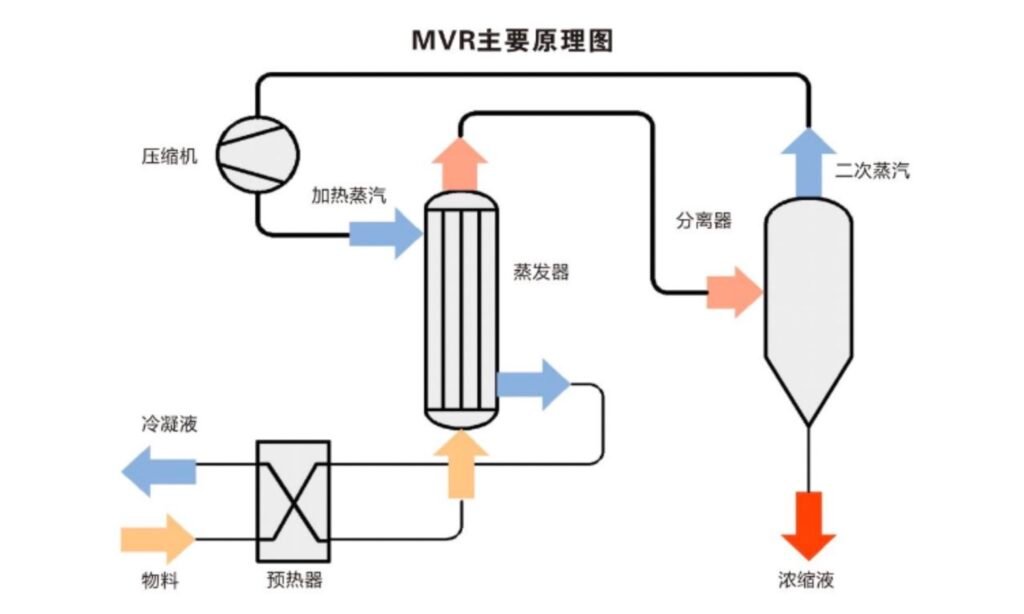
Key energy transformation path:
Electrical energy input → compressor work
Mechanical compression → vapor enthalpy increase
Condensation → latent heat transfer to feed
Closed-loop heat recovery cycle
Key parameters to label:
COP: 3–10
ΔT: 3–15°C
Energy consumption: 15–75 kWh/m³
Figure 2 – System Process Diagram (Mechanical Vapor Recompression(mvr)evaporator)
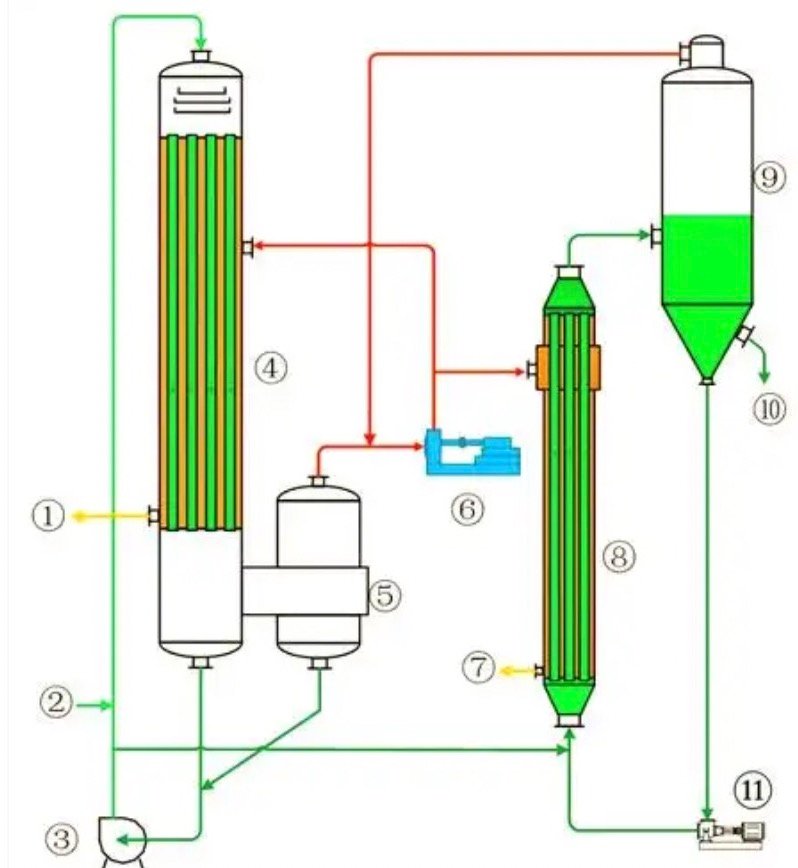
System components:
Feed tank
Evaporator unit
Vapor–liquid separator
Vapor compressor
Heat exchanger / condenser
Liquid circulation loop
Flow labeling:
Vapor flow loop (gas phase circulation)
Liquid circulation loop
Electrical energy input path
Successful Project :
Salt waste water treatment/SALT WASTE WATER TREATMENT NACL SOLUTION/Salt maker
The company is a chemical products factory and the main production chemical crystal particles Such as wastewater containing high concentration of salt and after many times of experiment the conclusion .My company eventually adopt the crystallizer of continuous production . The moisture of salt crystallization and centrifugal separation. Final disposal by the customer.after that the water can be put into production again after the treatment.
Project information :
1. Medium:sodium chloride,Sodium Sulfate, Nacl solutions
2. Handing capacity : 1000 kg / hr
3. Material of machine : SS316L,titanimum
4. Service Life : 10 years
5. Plant Operation : Continuous, 24 hours per day, 365 days per annum
6. Plant Availability : 91.3% – 95%
Pictures :

Installation video of it :
MVR evaporator (cryogenic evaporator) is currently the most advanced evaporator technology in the world.
its characteristics are as follows:
1) There is no waste heat steam emission. And the energy-saving effect is very significant.equivalent to a 10-effect evaporator.
2) The use of this technology can realize counter-current scrubbing of secondary steam So the dry matter content of condensate is much lower than that of multiple evaporators.
3) The use of low temperature negative pressure evaporation (50-90 °C) is conducive to preventing the high temperature denaturation of the evaporated material.
Mechanical Vapor Recompression(mvr)evaporator characteristics are as follows:
4)4.1 Mechanical vapor recompression evaporator. MVR evaporator is a replacement product of the traditional multi-effect falling film evaporator. Which is reused by countercurrent washing and recompression of secondary steam on the basis of single-effect evaporator. All materials suitable for single-effect and multi-effect evaporators are suitable for MVR evaporators. Which are technically completely fungible and have better environmental protection and energy-saving characteristics.
MVR evaporator is also known as cryogenic evaporator or MVR energy-saving evaporator. MVR evaporator is the use of the evaporator to produce the secondary steam vaporization latent heat. Even if the temperature of the secondary steam is only 80 degrees But considering the enthalpy value is not low. Such as 80 degrees calorific value 2200kj. 100 degrees calorific value 2280kj. In fact. The calorific value is only dozens of kj. If by what way to use this part of the thermal energy, then you can use this energy again.
MVR evaporator is to use the compressor to increase the energy of the secondary steam. That is. The 80 degrees of secondary steam through compression to 100 degrees. The actual input calorific value is only thirty kj. Considering the energy loss, is to 30kw can evaporate a ton of water. So the use of MVR evaporator is an energy-saving MVR evaporator. much better than the traditional evaporator energy-saving effect.
4)4.2
The use of MVR evaporator to consider the reason for the temperature rise. The material is best boiling point liter not more than 20 degrees. Otherwise the energy consumption of the compressor will be greatly increased. Successful case materials include: sodium sulfate, ammonium sulfate, sodium chloride, ammonium chloride, tartaric acid, glucose, itaconic acid and so on.
MVR evaporator technology due to its remarkable energy-saving effect. Began to develop rapidly abroad in the 70s. And has been widely used in industrial wastewater treatment and ammonium sulfate. Sodium sulfate. Sodium chloride. Seawater desalination, coking plants (recovery of sulfur dioxide to produce sulfur ammonia). Salt chemical industry and many other production fields. No raw steam is required during evaporation. Greatly reduce operating costs. while achieving energy saving and emission reduction .
4)4.3
The working process is that the steam at low temperature is compressed by the compressor As a Result. The temperature and pressure are increased, and Consequently ,The enthalpy is increased,After that it enters the heat exchanger to condense to make full use of the latent heat of the steam. In addition to start-up, no steam is required throughout the evaporation process. In the multi-effect evaporation process. The secondary steam of a certain effect of the evaporator cannot be directly used as the heat source of the primary effect. But can only be used as the heat source of the secondary effect or the secondary effect. If it is used as an effective heat source, it must be given additional energy to increase its temperature (pressure). Steam jet pumps can only compress part of the secondary steam. While MVR evaporators recover all the secondary steam in the evaporator.
4)4.4
The principle of MVR mechanical recompression evaporator MVR steam mechanical recompression evaporator is an efficient and energy-saving technology compared with traditional multi-effect evaporation. MVR evaporator refers to mechanical thermal compression evaporator Which is a new type of high-efficiency evaporation equipment developed in the late nineties of the twentieth century.
4)4.5
Mechanical vapour recompression evaporator working principle is that the secondary steam generated by the evaporator is subjected to a mechanical thermal compressor (similar to a blower). The temperature is increased by 5~8 °C. And the heating heat source used for the evaporator is returned. And the fresh steam is only used to supplement the heat loss and supplement the enthalpy of the inlet and outlet materials. Thereby greatly reducing the consumption of external fresh steam by the evaporator. The original steam to be discarded has been fully utilized and The latent heat is recovered In this case the thermal efficiency is improved. And the economy of raw steam is equivalent to 20-30 effects of multi-effect evaporation. Reducing the demand for external heating and cooling resources, reducing energy consumption and reducing pollution.
MVR evaporator can achieve low temperature evaporation. The evaporation temperature is from 45 degrees to 100 degrees. And MVR can save energy compared to traditional multi-effect evaporators because it recovers secondary steam. By replacing the steam input with the input of electric work. MVR reduces operating costs. For every 1 t of water vapor evaporated. MVR can save 12.9% of standard coal compared with the five-effect evaporator. Compared to the first-effect evaporator, it can save 78.6% of standard coal. In addition. For every 1 t of water vapor evaporated. MVR operation cost can save 2.3 US$ compared with three-effect evaporation. Which is equivalent to four-effect evaporation.
FAQ (Frequently Asked Questions) about our Mechanical Vapor Recompression(mvr)evaporator
Q1: What is an MVR evaporator used for?
An MVR evaporator is used for industrial evaporation, concentration, and wastewater treatment by recycling vapor latent heat through mechanical compression.
Q2: Why is MVR more energy efficient than conventional evaporators?
Because it reuses latent heat from secondary vapor instead of requiring continuous external steam generation.
Q3: What is the main energy consumption in an MVR system?
The vapor compressor, which typically accounts for 60–85% of total energy consumption.
Q4: Where is MVR evaporator commonly used?
It is widely applied in wastewater treatment, chemical processing, food concentration, pharmaceutical production, and ZLD systems.
Q5: What are the main limitations of MVR technology?
Key limitations include low allowable ΔT range, scaling risks, sensitivity to feed variation, and performance reduction under high BPE conditions.