
What is Forced Circulation Evaporator
Forced Circulation Evaporator Engineering Guide for High-Viscosity Liquids
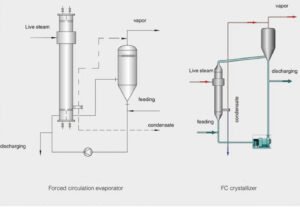
Forced circulation evaporator uses a pump to drive liquid at high velocity through a heat exchanger, preventing boiling on the heating surface. The heated liquid then enters a flash chamber where evaporation occurs. This design minimizes fouling, scaling, and crystallization, making it ideal for viscous, heat-sensitive, or crystal-forming fluids. It is widely used in chemical, food, and wastewater treatment industries.
Forced Circulation Evaporator Core Operating Mechanism and Fluid Dynamics
Suppressed Boiling Protocol via Hydrostatic Head
To entirely eliminate scaling within the heat exchanger tubes, the system must suppress the boiling phase change until the fluid enters the flash vessel. Centon achieves this by installing the heat exchanger horizontally or vertically at a minimum static height of 4.5 to 6 meters below the separator liquid level.
This liquid column generates a hydrostatic pressure surplus .ensuring that even when steam heats the process fluid to 3℃~to 5℃ above its atmospheric boiling point.the fluid remains in a 100% liquid phase.
Velocity Limits and Shear Stress for Non-Newtonian Fluids
As concentration rises, industrial fluids exhibit pseudo-plastic or non-Newtonian behavior, where apparent viscosity can spike from 10 cP to over 1,500cP. To counteract the boundary-layer adhesion of these thick sludges, an axial flow pump delivers a continuous tube velocity of 2.0 to 3.5m/s.
according to fluid dynamic modeling, this velocity generates a wall shear stress exceeding 45pa, which continuously scours the inner walls of the Titanium or 316L SS tubes, reducing the thermal resistance of the fouling layer to less than 0.0001m2.K/W.
Technical Comparison: Forced Circulation Evaporator vs. Falling Film Evaporator.
When treating industrial effluents or process streams, selecting between forced circulation and falling film geometries depends strictly on viscosity limits and suspended solids.
| Technical Parameter | Falling Film Evaporator | Forced Circulation Evaporator |
| Maximum Apparent Viscosity | ≤100cP | ≤2,500cP |
| Maximum Total Suspended Solids (TSS) | <1%w/w (No crystals) | ≤35% to 50%w/w (Slurry) |
| Average Heat Transfer Coefficient (K) | 1,800−2,800W/m2⋅K | 1,100−1,600W/m2⋅K |
| Tube Pass Fluid Velocity | 0.5−1.0m/s (Gravity film) | 2.0−4.0m/s (Driven by pump) |
| Typical Cleaning Cycle (CIP) | Every 48−72Hours | Every 30−45Days |
While falling film evaporator units offer higher heat transfer coefficients at low viscosities, their gravity-driven film ruptures when processing liquids above 100cP, leading to dry-spots and immediate tube baking. The forced circulation evaporator sacrifices a portion of thermal efficiency (K-value) but ensures uninterrupted operation under severe crystallization conditions.
Energy Integration and Operational Expenditure
Operating a forced circulation loop requires significant electrical power due to the high-flow requirements of the circulation pump. Centon integrates two thermodynamic configurations to minimize the total energy per ton of evaporated water.
Mechanical Vapor Recompression (MVR) Integration
By coupling the FCE with a centrifugal fan or high-speed turbo blower, the system compresses the exhaust vapor from the flash separator, raising its saturation temperature by 8℃ to 12℃. This compressed vapor is recycled back into the shell side of the FCE heat exchanger as the primary heating medium.
*Specific Electricity Consumption:22 to 38kWh per ton of evaporated water.
*Steam consumption :0kg/t during steam-state operation(only required for 30min startup).
*Optimized through specialized system [MVR (Mechanical Vapor Recompression) integration.
Mitigating Erosion and Foam in High-Solid Slurries
Computational Fluid Dynamics (CFD) Entry Angle
High velocities paired with salt crystals create an abrasive environment. Standard 90℃ separator inlets experience localized erosion-corrosion failure within 12 to 18month.
Centon engineers use a 15° tangential downward entry nozzle combined with an internal SS316L sacrificial wear plate.we have confirms this geometry redirects the kinetic energy of the slurry into a controlled vortex, reducing wall shear stress variance by 68%.
De-foaming and Entrainment Mitigation of Forced Circulation Evaporators
High-viscosity organic waste often generates stable micro-foams during flashing, leading to liquid entrainment (carry-over) into the condensate line. Centon implements a two-stage separation mechanism:
*Vortex Centrifugal Separation: Forces liquid droplets outward against the vessel walls.
*chevron Mist Eliminator: A multi-blade profile with a face velocity of 1.8 to 2.4 m/s, that captures particles down to 10um, keeping carry-over TDS below 10 ppm.
Critical Mechanical Component Specifications about the Forced Circulation Evaporators
*Circulation Pump: Low-speed (450 – 740 RPM), large-diameter axial flow pump. Lower RPM reduces crystal breakage by 55%, maintaining uniform crystal sizes ($0.5 – 0.8 mm) for easier downstream centrifuging.
*Shaft Sealing: Single or double cartridge mechanical seals equipped with an independent pressurized flush system using condensate water at 0.5bar above the product operating pressure. This eliminates salt crystallization at the seal faces, backed by Centon’s
*Heat Exchanger Tubes: Minimum wall thickness of 2.11 mm(BGW 14)for highly abrasive slurries, deviating from standard $1.65 mm.specifications to provide an extended corrosion allowance.
How To Design and Size a Forced Circulation Evaporator
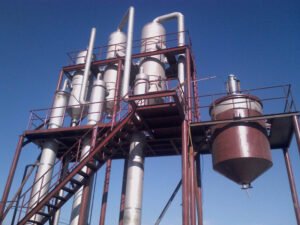
After installation :A Forced Circulation Evaporator was finished design after installation at factory. as follows:
FAQ:
When should a forced circulation evaporator be used?
A forced circulation evaporator is best used when liquids have high viscosity, contain suspended solids, or tend to form scale during evaporation. It maintains stable heat transfer and supports higher solids concentration.
What are the advantages of forced circulation evaporators?
The main advantages are reduced fouling, higher heat-transfer efficiency, reliable operation with difficult liquids, and the ability to handle crystallizing solutions. This often results in longer operating cycles and lower maintenance.
How does a forced circulation evaporator different from a falling film evaporator?
A forced circulation evaporator relies on pump-driven recirculation, while a falling film evaporator uses gravity-driven thin films. Forced circulation units perform better with viscous or scaling products, whereas falling film systems suit low-viscosity liquids.
What industries use forced circulation evaporators?
Forced circulation evaporators are widely used in food processing, dairy, chemical manufacturing, wastewater treatment, pharmaceuticals, and salt production where high solids or scaling conditions are common.
Can a forced circulation evaporator handle crystallization processes?
Yes. Forced circulation evaporators are specifically designed to manage crystallizing liquids. High circulation velocity keeps crystals suspended and minimizes deposits on heat-transfer surfaces