
What is a Falling Film Evaporator?
A falling film evaporator forms a thin liquid film (0.1–0.5 mm) on vertical tubes, enabling rapid evaporation with very short residence time.
Falling Film Evaporator’s Key Performance Data
Heat transfer coefficient: 2000–5000 W/m²·K
Residence time: 5–30 seconds
Vacuum level: –0.08 to –0.095 MPa
Efficiency: 20–40% higher than forced circulation
Advantages of Falling Film Evaporator
Falling Film Evaporator is Low-temperature operation
Works at 40–70°C, ideal for heat-sensitive materials
Falling Film Evaporator’s Energy efficiency
Steam consumption is 20–35% lower than forced circulation systems.
Falling Film Evaporator’s Product protection
Reduces thermal degradation by 30–60%.
Falling Film Evaporator’s Limitations
Not suitable for viscosity above 1000 cP
Requires uniform liquid distribution (≥90% efficiency required)
Falling Film Evaporator’s Applications
Juice concentration (Brix 10 → 65)
Dairy pre-concentration
Pharmaceutical low-temperature evaporation
* Applicable range
It is suitable for evaporation and concentration of various materials, especially for materials which are not easy to scale, evaporate easily or have strong thermal sensitivity.
* System components
Evaporation part , separator part , condenser , vacuum system, water discharge system , material in every effect , pumps, working platform , Electrical instrumentation control cabinet and valves, piping system composition.
* Multi-effect evaporation concentration equipment
When the new steam enters the first effect as a heat source, the second effect is introduced into the second effect, and so on. Multiple evaporators are connected and operated together, that is, a multi-effect evaporation system is formed. In the multi-effect evaporation system, the latent heat of steam can be reused, which can significantly reduce the energy consumption, greatly reduce the energy consumption and improve the thermal efficiency.
* Use the most common evaporative enrichment equipment.
* As the number of potency increases, steam consumption is more economical.
* Although the equipment is less expensive to invest, it consumes a large amount of steam and thus imposes a large energy burden.
* Is suitable for concentrated evaporative crystallization of steam where the price is lower.
* Main characteristics
* Pump flow rate is relatively small, low installed power, low power consumption.
* Concentration ratio is large, falling film evaporation, concentration time is short.
* Special design can be easily operated to achieve switching efficiency to adapt to different products.
* Evaporator top spraying material or through multiple overflow film device ensures the material and liquid evenly distributed in the evaporator film tube, forming a film shape, which greatly improves the heat transfer coefficient and increases the evaporation rate, thus preventing “dry wall” phenomenon.
* Feed liquid at the bottom of the evaporator vapor liquid separation, into the separator and then separation, strengthening the separation effect.
* Large equipment adopts vertical and vertical structure, with compact structure, small footprint, simple and smooth layout, representing the development aspect of large complete sets of evaporation equipment.
* Equipment with CIP cleaning pipeline, can be cleaned easily .
*Technical Date
Beside this sheet , we also can design according to client different requirement with different proposal .
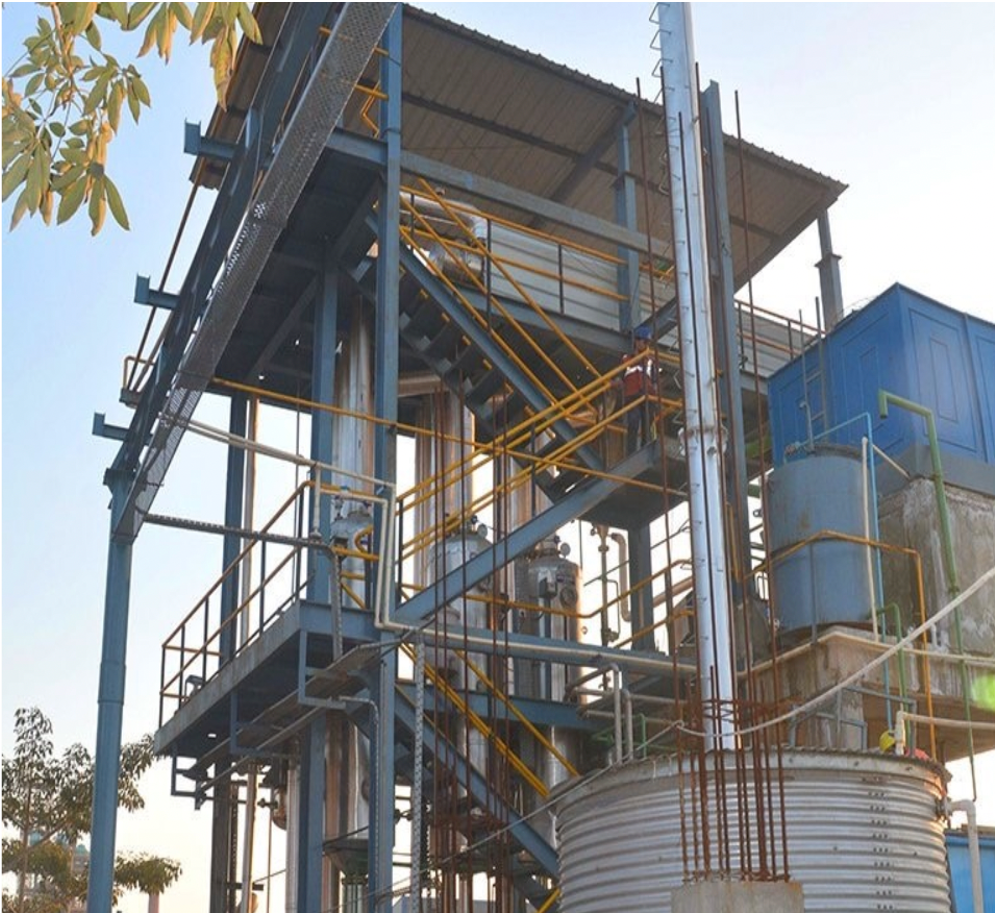
 Falling Film Evaporator after installation
Why is it more efficient(Falling Film Evaporator)?
Thin film (0.1–0.5 mm) reduces thermal resistance, achieving 20–40% higher efficiency than forced circulation.
Multi-effect system?
2–5 effects reduce steam use 30–70%.
Forced circulation comparison?
Falling film is 20–40% more efficient but limited to <1000 cP
Single vs multi-effect ?
Single uses 1.0 kg steam/kg water. multi-effect 0.2–0.5
Hybrid with MVR ?
Yes, MVR + falling film reduces energy 60–85%
Falling evaporator vs rising film evaporator ?
Falling film: gravity, 5–30s. rising film: vapor lift. 30–120 s. Efficiency +20–40% for falling film.